
How a Buenos Aires accounting firm cut monthly bank reconciliation from 32 hours to 20 minutes
How we built a custom reconciliation engine for Estudio Contable Tuculet, turning a 4-person-day monthly chokepoint into a junior's morning task.
| Company | Estudio Contable Tuculet |
| Industry | Accounting services |
| Size | 7 employees |
| Location | Buenos Aires, Argentina |
| Challenge | Monthly bank reconciliation across 50 clients consumed two senior accountants for two full days; an eighth hire was on the table |
| Result | Reconciliation cut from ~32 person-hours to 20 minutes per close (>99% reduction); hiring shelved; two seniors redeployed to advisory work |
Situation
Estudio Contable Tuculet is a seven-person accounting firm in Buenos Aires that manages the books, including monthly bank reconciliation, for roughly 50 Argentine SMBs. Their client portfolio spans the full range of the local banking system: Santander, Credicoop, Comafi, Provincia, Nación, Ciudad, ICBC, Macro, and MercadoPago. Each bank exports statements in its own PDF layout. None of them offer clean machine-readable feeds by default in the Argentine market, and none match the formats Argentine accounting software uses internally.
This isn't a niche problem. Industry benchmarks put the average firm's month-end reconciliation at more than 8 business days, and firms of Tuculet's size routinely burn over 20% of billable capacity on reconciliation work that generates no direct revenue. For a growing boutique firm, that's a tax on every new client they take on.
Task
For Tuculet, the cost was concrete and visible every month. Two senior accountants did nothing but reconciliation for two straight working days, roughly 32 person-hours of uninterrupted, cognitively draining matching work across 50 clients. During that window, those two were unavailable for anything else: no advisory calls, no tax planning, no client-facing work that carried premium billing rates.
The deeper cost was hidden in what the structure prevented. Adding a new client meant absorbing another few hours of that monthly grind into an already-maxed process. The partners had begun discussing hiring an eighth accountant, not to do higher-value work, but simply to survive the reconciliation load.
The specific reconciliation pain had three recurring faces that off-the-shelf tools didn't handle well:
- Check clearing timing. Checks appear in accounting records on issue date but hit bank statements on clearing date, often 10 to 20 days later, sometimes crossing month boundaries entirely.
- Tax-withholding fragmentation. A single client deposit routinely arrives fragmented across multiple rows due to tax withholdings, with rounding differences of a few centavos that break exact-amount matching.
- Recurring descriptions. The same unmapped bank-fee descriptions appeared month after month, requiring the same manual categorization from scratch every time.
Action
Tuculet engaged us to build a purpose-built reconciliation engine designed around the Argentine banking reality, not adapted from a US or European tool. The solution went live in January 2026.
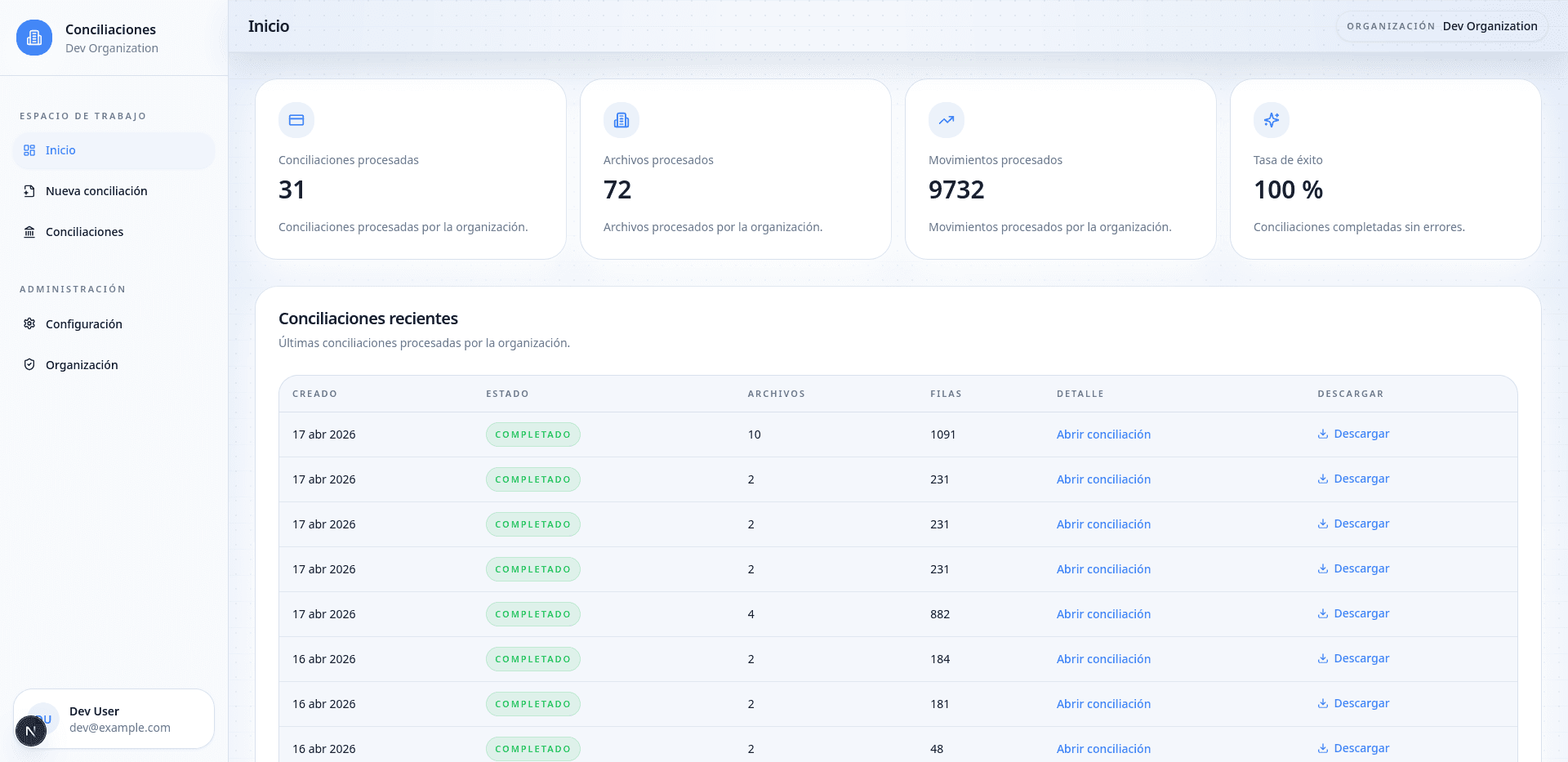
Multi-bank PDF ingestion. The engine parses statements from all nine supported Argentine banks, handling each bank's specific PDF layout. Accountants upload each client's bank statement PDFs alongside their accounting extract in a single batch import.
Six-round matching engine. Automated matching runs in progressive rounds: exact matches first, then check-number matching that tolerates clearing-date gaps, then grouped matches for tax-fragmented deposits within a ±0.10 tolerance, then a "same-period" rule for date-mismatched entries, and finally net-zero grouping for reversals and corrections. The result: 98% of movements match automatically.
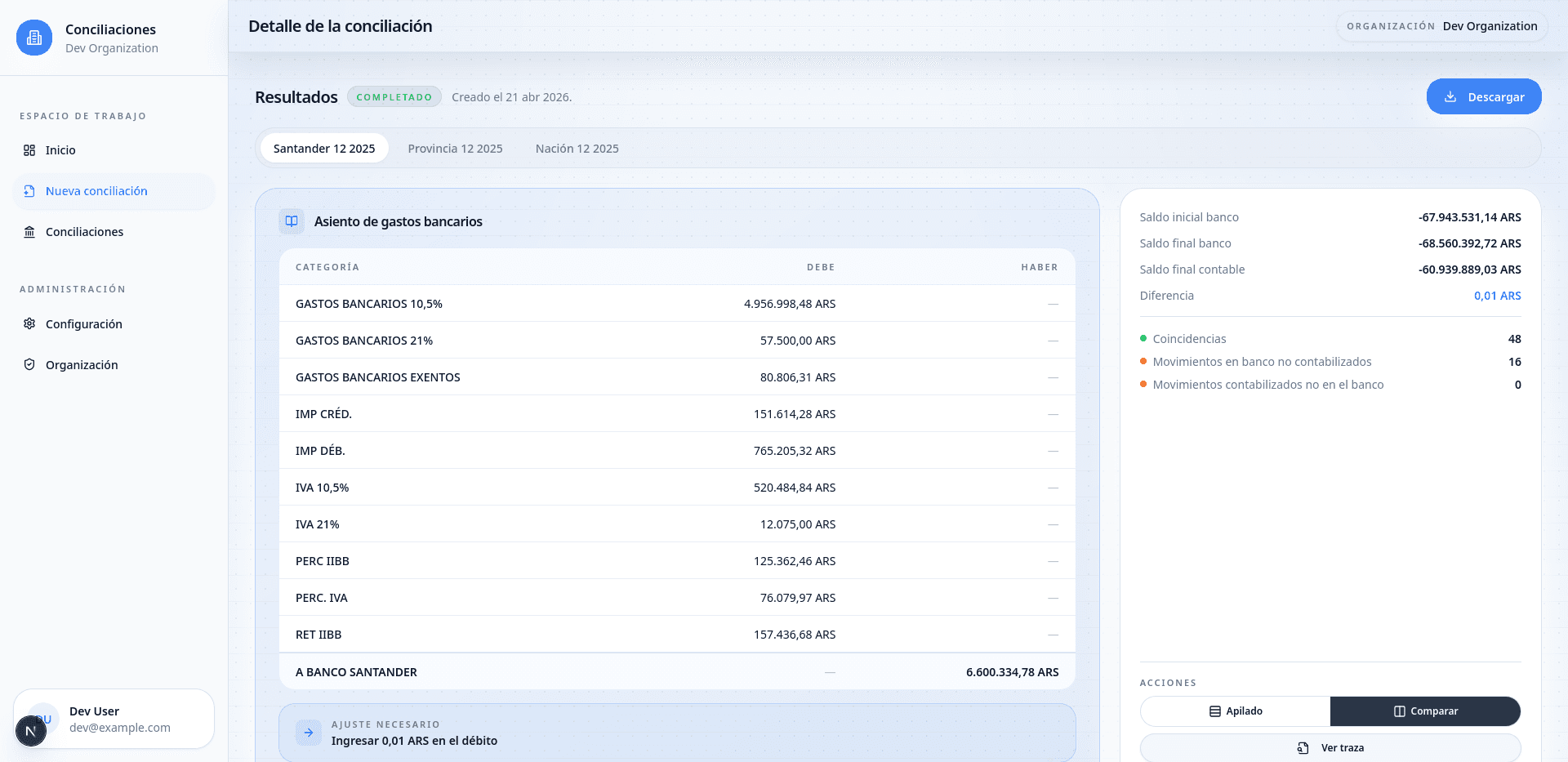
Frictionless human review. Unmatched rows, roughly 2% of total movements, surface in a dedicated review interface where accountants drag-select and link them manually. No spreadsheet context-switch, no hunting through PDFs.
Category memory. Recurring descriptions map to categories once, then auto-categorize every future month. A decision made in January doesn't need to be remade in February.
Deliverable-ready exports. Results export to PDF and Excel for client deliverables, matching the formats Tuculet already sends to its clients.
The design priority was ruthless: automate what's deterministic, make the remaining human review frictionless, and keep an accountant from ever re-doing a decision they've already made once. The tool doesn't try to be a general-purpose reconciliation platform. It's built for one country's banks, one firm's workflow, and one specific monthly ritual.
Rollout was deliberately gradual. Over three monthly closes between January and April 2026, Tuculet ran the tool alongside the old process, validated results, and then cut over fully.
Results
Within three monthly closes, the impact was measurable across every dimension of the firm's reconciliation operation:
| Metric | Before | After | Improvement |
|---|---|---|---|
| Time per monthly close | ~32 person-hours | ~20 minutes | >99% reduction |
| People required | 2 senior accountants | 1 junior | Halved + deskilled |
| Wall-clock days blocked | 2 full working days | Part of one morning | Crunch eliminated |
| Auto-match rate | 0% (fully manual) | 98% of movements | Near-complete |
| Hiring plan | Eighth hire under discussion | Shelved | Avoided |
Beyond the numbers, the structural change was larger. The two senior accountants who used to spend those two days on matching now spend that capacity on advisory and tax-planning work, the billing categories that actually justify their rates. The eighth-accountant hire that was on the table before the tool is now shelved. And with reconciliation no longer scaling linearly with headcount, the firm can now take on additional clients without the month-close bottleneck.
"Reconciliation used to block two of our senior accountants for two full days every month. Now a junior runs it in twenty minutes. It's not an incremental improvement, it changed what our firm is capable of."
— Mateo Tuculet, Owner, Estudio Contable Tuculet
Built for the Argentine banking reality, not adapted from somewhere else. Tuculet's reconciliation engine proves that the most valuable automation isn't the one with the most features, it's the one that eliminates the monthly ritual holding a firm back from the work it actually wants to do.