
How Charlie Foltz Media replaced three tools with one ledger for a six-figure sync catalog
How we built a custom licensing ledger that unified 250+ licenses across 100+ brands, ended missed royalty registrations, and cut weekly admin for a one-person music licensing business.
| Company | Charlie Foltz Media LLC |
| Industry | Music Sync Licensing |
| Size | Solo operator |
| Location | United States |
| Challenge | A six-figure licensing catalog tracked across QuickBooks, Disco, and memory, with no single source of truth |
| Result | 250+ licenses and 100+ brands unified into one ledger, zero missed royalty registrations, and ~80% less weekly admin |
Situation
Charlie Foltz is a composer who licenses his own catalog of music to brands for commercials, digital campaigns, and broadcast. Working solo as Charlie Foltz Media LLC, he has placed tracks with some of the most recognizable names in advertising, including Apple, Coinbase, Venmo, Google, and Wendy's.
Over 5+ years, that work added up to a six-figure operation: more than 250 individual licenses across 100+ brands, brokered through many different sync agencies. Music sync licensing is precise and deadline-driven. The terms of each deal (usage, territory, exclusivity, duration) matter as much as the music itself.
Challenge
The catalog had outgrown the tools holding it together. Charlie tracked accounting in QuickBooks, his music in Disco, and a surprising amount of everything else in his head. None of those systems talked to each other.
That fragmentation cost him. Roughly ten hours a week disappeared into invoicing by hand, reconciling QuickBooks against Disco, scanning for what was expiring, and rebuilding the same reports at tax time.
The worse problem was what slipped through entirely. Broadcast placements earn performance royalties, but only if the cue is registered in time, and more than once that window quietly lapsed. That money just went unclaimed. And with exclusive deals live across the catalog, there was always a risk of granting a new license that collided with one already in force.
I was running a real business out of a spreadsheet and my own memory. I knew it was a problem. I just didn't have time to fix it while doing the actual work.
— Charlie Foltz, Composer & Owner, Charlie Foltz Media LLC
Action
We built the Charlie Foltz Ledger, a single platform shaped around how a sync licensor actually works. Shipped it in six weeks, and it has been in daily use ever since.
One source of truth. The ledger unifies the catalog, every license, demos, and invoicing into one system. Tracks, brands, usage types, terms, and exclusivity all live together, replacing the QuickBooks, Disco, and memory patchwork with one authoritative record.
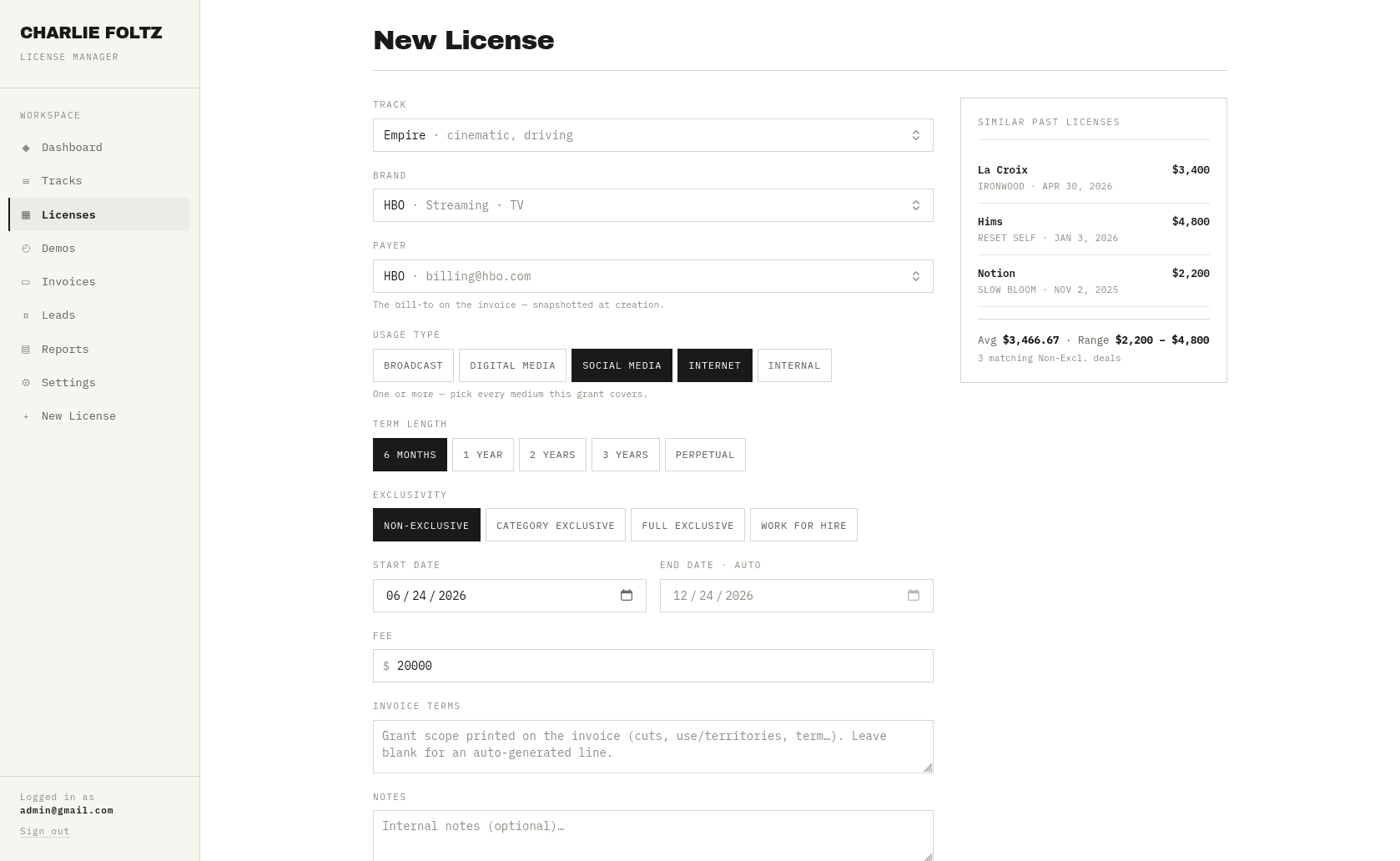
Smart license capture. Recording a license takes terms, usage, exclusivity, dates, and the bill-to in a single form. It also surfaces comparable past deals as live pricing guidance, so Charlie can quote with the catalog's own history behind him.
Automatic, gapless invoicing. Creating a license or demo issues an invoice automatically, with continuous sequential numbering and a locked-layout PDF. Paid dates anchor cash-basis reporting, and a void-and-reissue flow handles corrections cleanly. No more manual numbering or gaps.
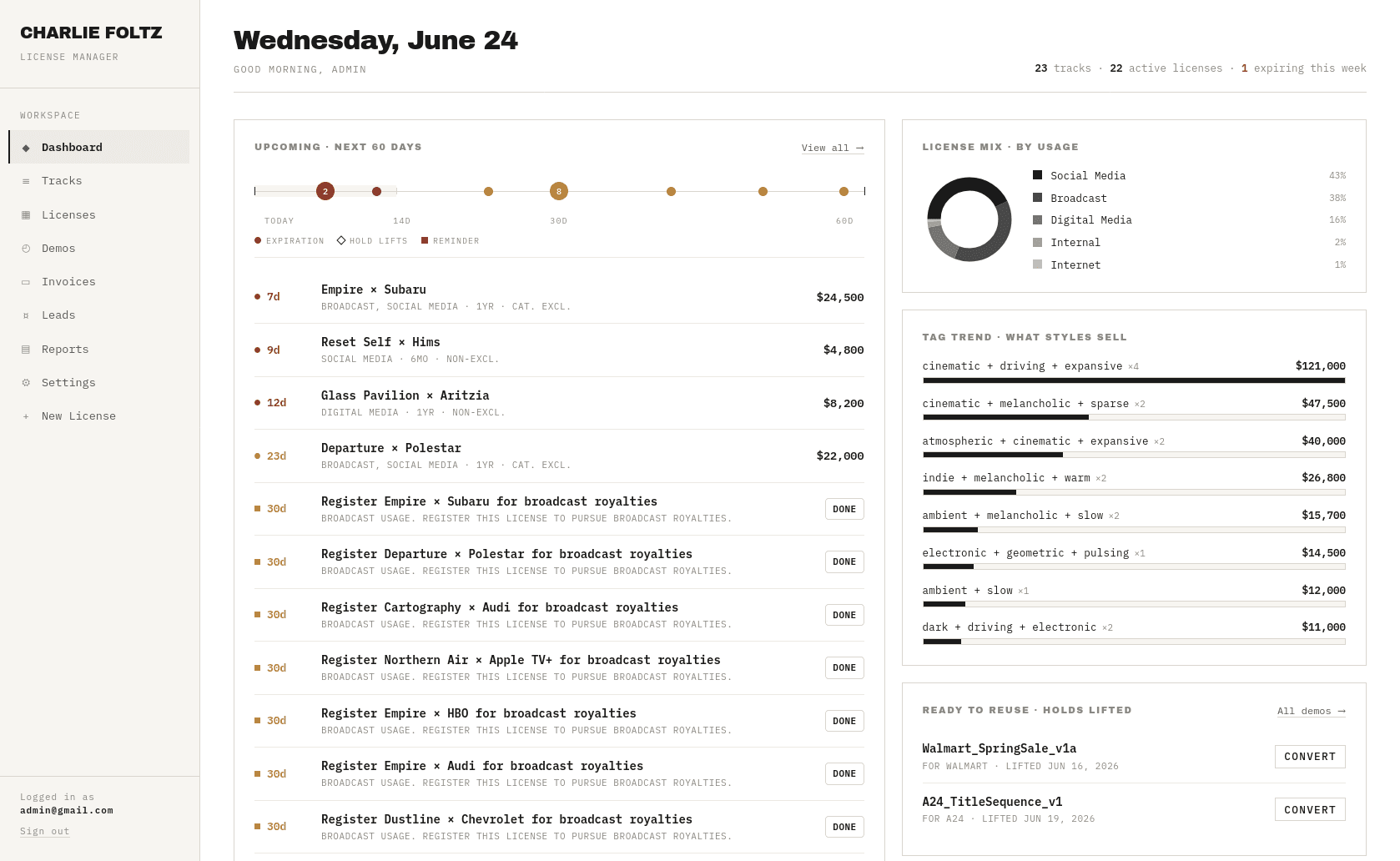
Royalty reminders that don't let money slip. When a license includes broadcast usage, the ledger automatically creates a reminder to register for performance royalties within the window. Overdue reminders never disappear. They stay until handled.
Exclusivity collision warnings. When Charlie records a new license, the ledger checks it against active exclusive grants in the same category and warns him before a conflict happens.
A dashboard and a Monday digest. Upcoming expirations, renewal windows, demos ready to reuse, and overdue invoices surface automatically, on screen and in a weekly email, so the scanning Charlie used to do by hand now does itself.
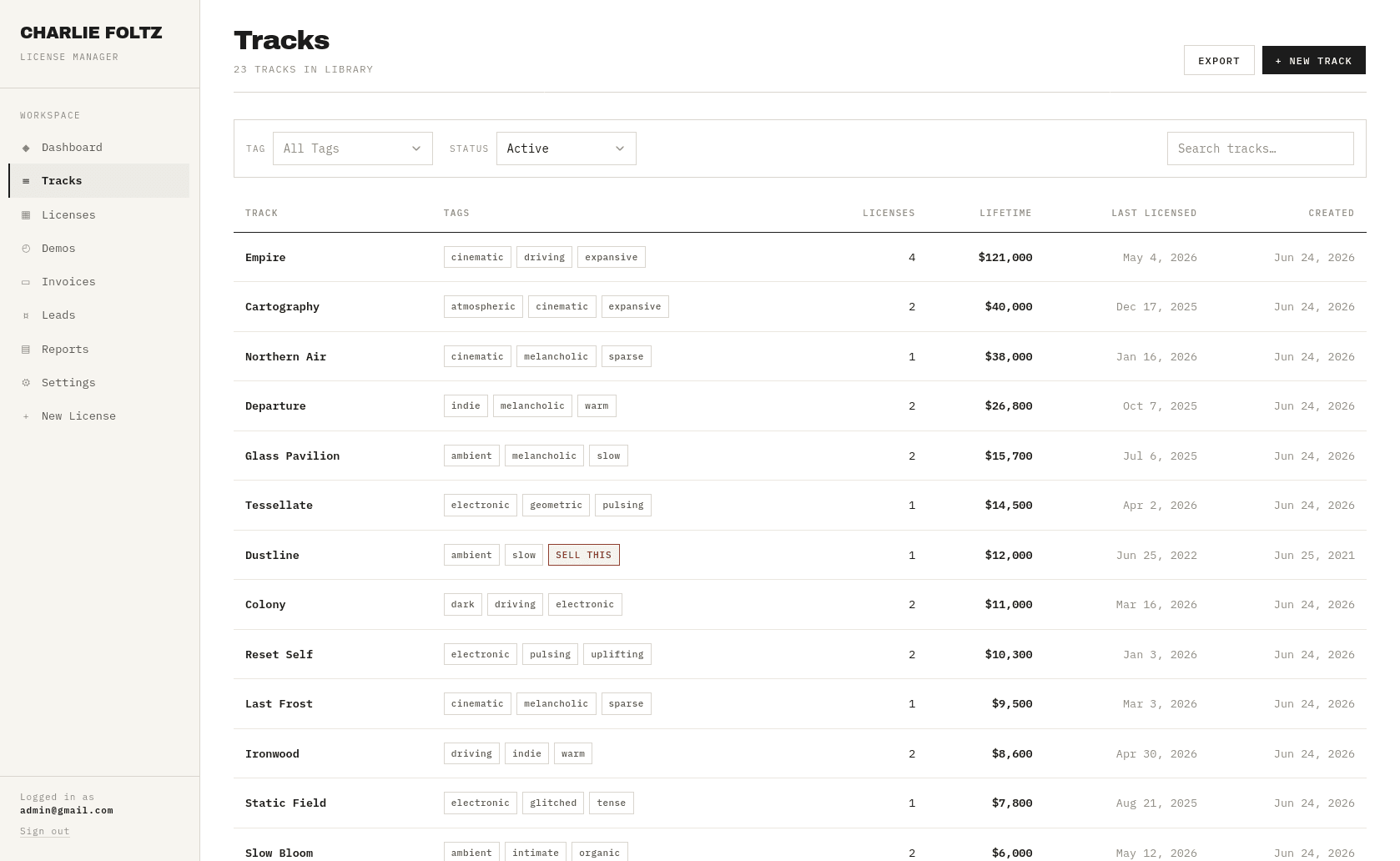
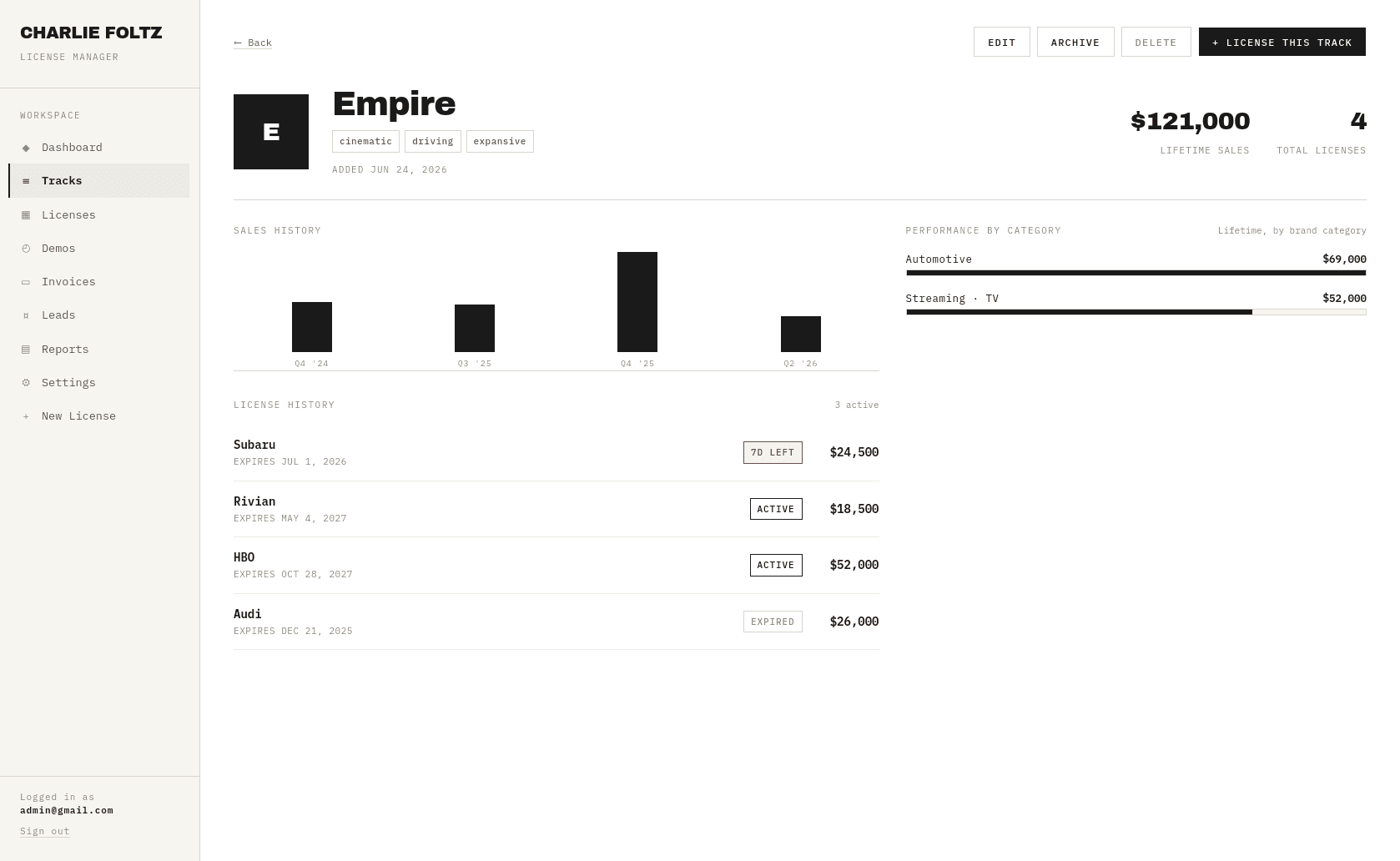
Reports and per-track insight. Cash-basis sales reports group by brand, agency, track, or usage type and export to CSV or PDF, turning tax-time prep from an afternoon into a moment. Every track also rolls up its own lifetime sales, license history, and performance by brand category.
Results
Within weeks of launch, the day-to-day ran differently.
| Metric | Impact |
|---|---|
| Systems of record | 3 tools → 1 ledger (QuickBooks, Disco, and memory consolidated) |
| Weekly admin time | Reduced ~80%, from ~10 hrs/week to under 1 |
| Missed royalty registrations | Zero since launch. Every broadcast license auto-flags its deadline |
| Lapsed renewals | Eliminated. Expirations surface weeks ahead |
| Tax & accountant reporting | Hours → minutes with one-click exports |
For a solo composer competing against rosters with full back-office teams, the ledger turned five years of scattered records into a system that protects revenue and catches conflicts before they happen. The admin mostly handles itself now, and the time goes back into the music.
You nailed it. I've stopped worrying about what I'm forgetting.
— Charlie Foltz, Composer & Owner, Charlie Foltz Media LLC