
How a Canadian restaurant chain cut daily reporting time by 95%
How we automated daily financial consolidation across 30+ restaurant locations, reducing reporting time from hours to minutes.
| Company | Multi-location quick-service restaurant chain (Canada) |
| Industry | Food service | Quick-service restaurants |
| Challenge | Manual consolidation of daily financial reports across 30+ stores into monthly spreadsheets |
| Result | Reduced daily reporting from ~3 hours to under 10 minutes, 95% time savings within the first month |
Situation
A quick-service restaurant chain operating over 30 locations across Canada needed to produce consolidated monthly financial spreadsheets covering every store's daily operations.
Each location generated its own daily business reports from the POS system and purchase invoices from suppliers, all in different formats. A dedicated team member was responsible for merging this data into a single standardized Excel workbook each month: one sheet per store, one row per day, tracking over 60 financial fields including net sales, tax breakdowns, payment processor totals, delivery platform revenue, supplier invoices, and bank deposits.
The spreadsheet served as the source of truth for accounting, compliance, and operational decisions across the entire chain.
Task
The consolidation process was entirely manual.
Every day, the operator had to open PDF business reports, locate the correct financial figures across multiple sections, and type each value into the right cell of the corresponding store's sheet. Purchase invoices arrived as CSV exports from the supplier system and required sorting by store, date, and expense category before being entered. With 30+ stores generating daily reports and multiple invoices per day, this meant manually entering hundreds of data points every session.
The process consumed an estimated 3 hours per day, roughly 60+ hours per month, only for data entry.
Worse, the manual nature of the work introduced transcription errors that were difficult to catch, sometimes leading to discrepancies in monthly financial reconciliation. Manual data entry commonly carries a 1-4% error rate.
Action
The chain engaged a development team to build a custom automation platform, deployed within one month. The solution addressed every stage of the data consolidation workflow:
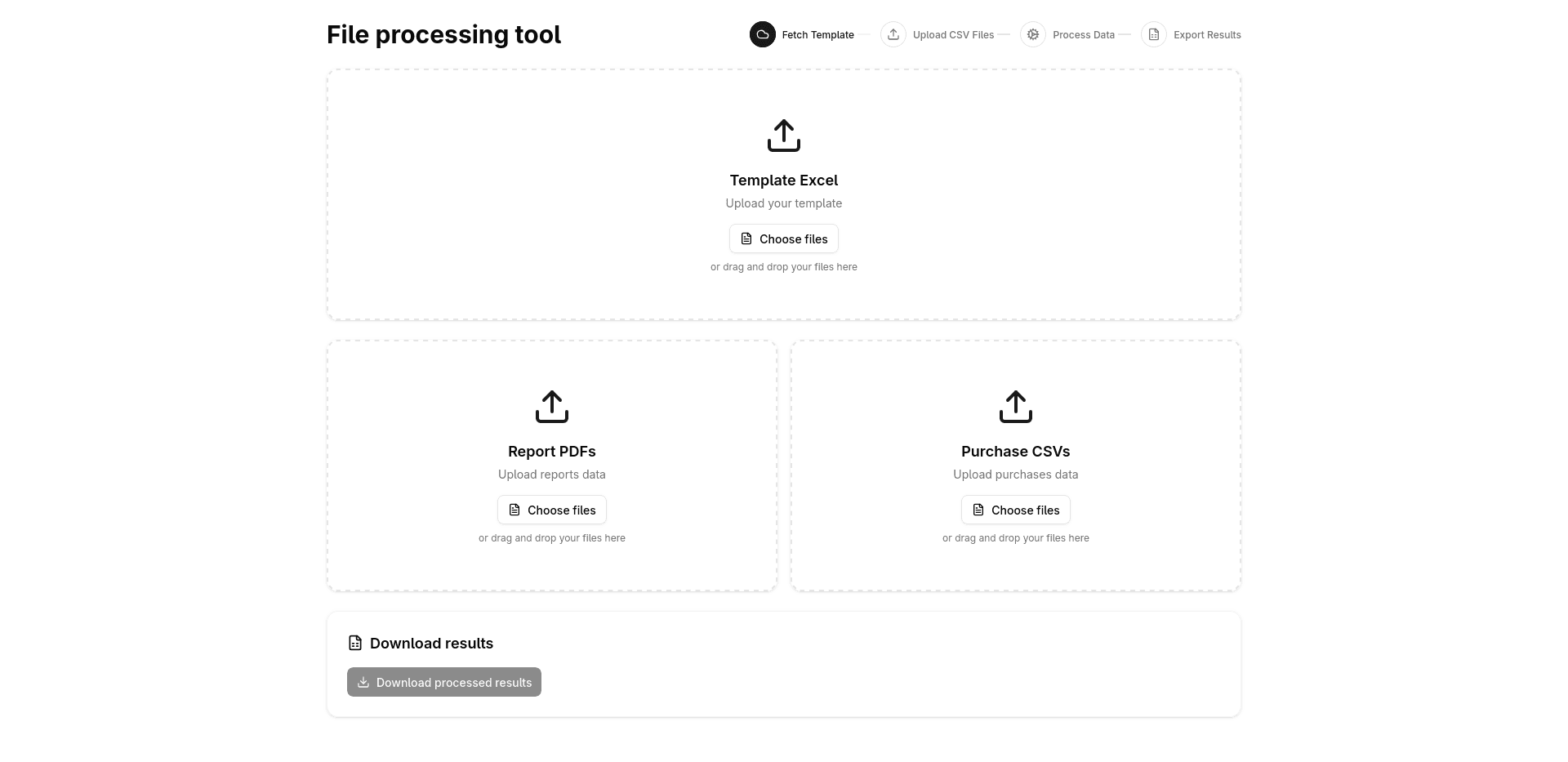
AI-powered PDF extraction. Daily business reports in different formats are uploaded to the platform, where an AI model reads each PDF and extracts 60+ financial fields into structured data. The AI handles varying PDF layouts and validates that required fields are present.
Automated CSV processing. Supplier purchase files are parsed and grouped automatically by store, invoice date, and expense category (food, paper, condiments, promotional items, and office supplies). The system aggregates amounts across multiple invoices without manual sorting.
Intelligent spreadsheet merging. Extracted data is merged directly into the client's existing Excel template. The system matches each report to the correct store sheet and date row, populates financial fields, and preserves existing VBA macros and formulas for downstream calculations. Purchase data is accumulated correctly even when multiple invoices exist for the same date.
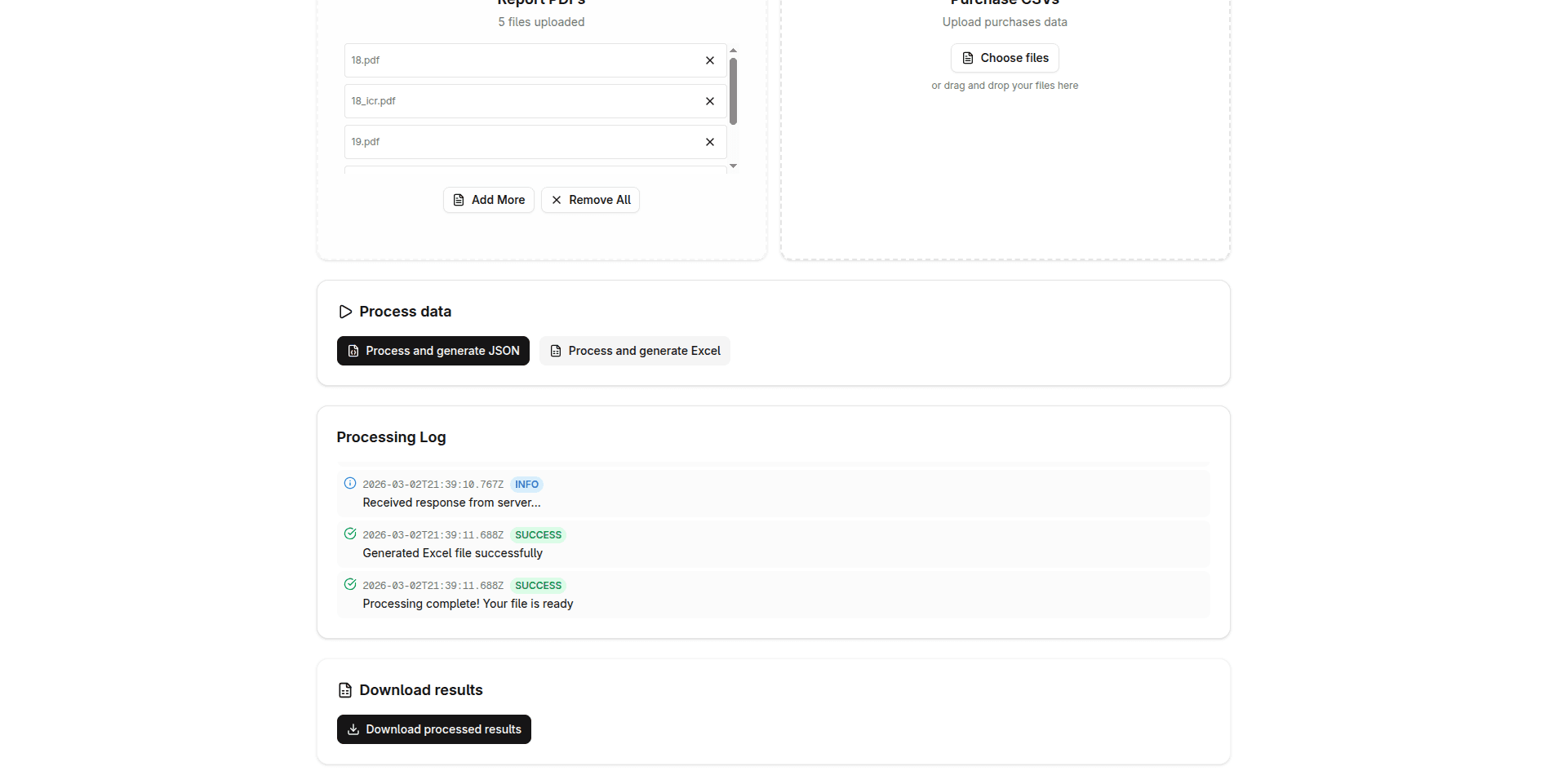
Built-in quality assurance. A real-time processing log shows each extraction step, flags missing or invalid data, and continues processing remaining files even when one report encounters an error, so a single bad PDF does not block the entire batch.
The platform was designed around the client's real workflow: upload the template, add the day's PDFs and CSVs, click process, and download the completed spreadsheet.
Results
Within three months since deployment, the platform delivered consistent, measurable improvements:
| Metric | Impact |
|---|---|
| Daily reporting time | Reduced by 95% (from ~3 hours to under 10 minutes) |
| Monthly operational time saved | 55+ hours |
| Data entry accuracy | Transcription errors effectively eliminated |
| Adoption friction | Zero, existing Excel and VBA workflows preserved |
Beyond speed and accuracy, the solution improved scalability. Adding a new location required only adding a sheet to the template, with no platform changes.
"Before this, I dreaded the end of each day because I knew I had hours of copying numbers from PDFs ahead of me. Now I upload the files, click a button, and the spreadsheet is ready."
— Operations Coordinator, Multi-Location Restaurant Chain